
Thanks to advances in technology, community-oriented businesses have found better ways to address social problems.
Ten years in the blink of an eye
Technology for development attracted considerable attention at the international conference: A Decade of Social Enterprise Development in Vietnam and Asia.
Opening with a reference to Doraemon’s “translation bread,” Tạ Minh Tuấn, Chairman of TMT Group and a Forbes 30 Under 30 Asia honoree, said that foreign languages would soon no longer be a barrier for people.
“In 10 years, we may still not have perfect Doraemon-like gadgets, such as translation machines that can do this for us,” he said, emphasizing that existing foreign-language business models would disappear.
“Like Uber: if it focused only on connecting passengers, it would also go out of business,” Tuấn added. The reason is that the future belongs to self-driving technology. Therefore, to avoid destroying itself, Uber must focus on new technologies.
Chairman TMT uses an assumed period of 10 years—neither too short nor too long—as a unit for measuring changes in human habits in the technological age.
“It may seem far off, but 10 years ago we did not have iPhones, we were not used to calling Uber or booking rooms on Agoda and AirBnB, and we had not yet given up our habit of sending SMS messages…” he said.
Technology has brought major changes in many ways. Social and volunteer activities have benefited too.
Tạ Minh Tuấn said he founded Light Charity in early 2018 to operate according to CSR (corporate social responsibility) standards. According to Tuấn, Light Charity also addresses problems in charity through technology.
Tuấn describes Lightone simply as an intermediary connecting people who want to donate clothing with disadvantaged people who want to receive it.
“There are always people who want to give,” Tuấn said, explaining that his organization collects clothing and delivers it to those who need it. However, these clothes are not free; they are sold for a symbolic price.
“Poor people have their dignity,” he said. Proceeds from clothing sales will support children with blood cancer. According to Tuấn, this will help improve patients' chances of survival.
Lightone has put 300,000 items of clothing back into circulation and affected hundreds of people, Tuấn estimates. He also says it has helped 50 leukemia patients avoid financial worries each month.
There are countless people who want to give and people who need to receive, yet connecting the two is not easy. Technology has addressed this problem, helping donors know where their money and gifts go and how they are used.
“Here is an opportunity for businesses, through blockchain or smart contracts,” Tuấn said, emphasizing that “Vietnam's charitable landscape will thereby become more transparent and effective, helping more people.”
Wind turbines and anti-corruption learning software
Lê Vũ Cường, founder and Director of 1516 Green Archi, brought to the seminar a story about wind turbines for disadvantaged people on the Red River in Hà Nội. Cường's project aims to provide a sustainable source of electricity for people living in poverty on boats on the Red River.
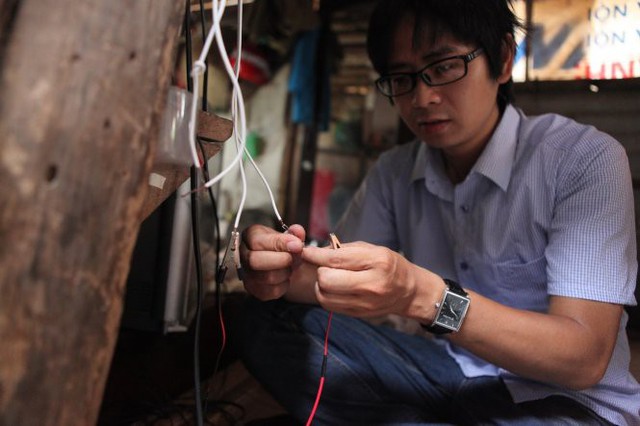
Lê Vũ Cường
“This is not a new idea,” Cường said. Nevertheless, for his project, wind power is timely because it supplies poor people with basic electricity. Although small in scale, the project incorporates system technology that allows monitoring and control through an app.
Cường considers the cost of these turbines reasonable, at around USD 200 for a complete newly installed system. “We do not sell to people living in poverty, but to NGOs,” he said.
Patipat Susumpao of Thailand, Director of Opendream, is interested in giving decision-making power back to citizens through technology. Together with his wife, Patipat founded a business focused on technological foresight for society in health and education.
In healthcare, Patipat developed the Doctor me app, which allows users to diagnose themselves. “Thailand has a universal healthcare program,” he said. Through the app, Thailand's hospital system can reduce its workload because people with mild illnesses do not necessarily need to visit in person.
“If we want to intervene in people's hospital journeys, we need to provide important information about their personal health and treatment,” he said. In addition, the company can analyze disease trends using the data collected.
The app currently has 800,000 users and 500,000 daily users.
Patipat has a rather interesting education app that uses role-playing games.
“We have programs such as anti-corruption, using 5 real corruption cases for players to role-play,” Patipat said.
In total, he has 78.000 players whose combined playing time reaches 34 years. “This is a way to advance public education,” he said, explaining: “Trying out being a bad person can be useful. It helps people understand the situation, whether such bad behavior is acceptable, and what risks it carries, so they can oppose it.”
According to Trí thức trẻ
Link to the original article on CafeF: http://cafef.vn/cau-chuyen-ve-nhung-cong-nghe-thay-doi-cuoc-doi-hang-tram-nghin-nguoi-20181010071858853.chn